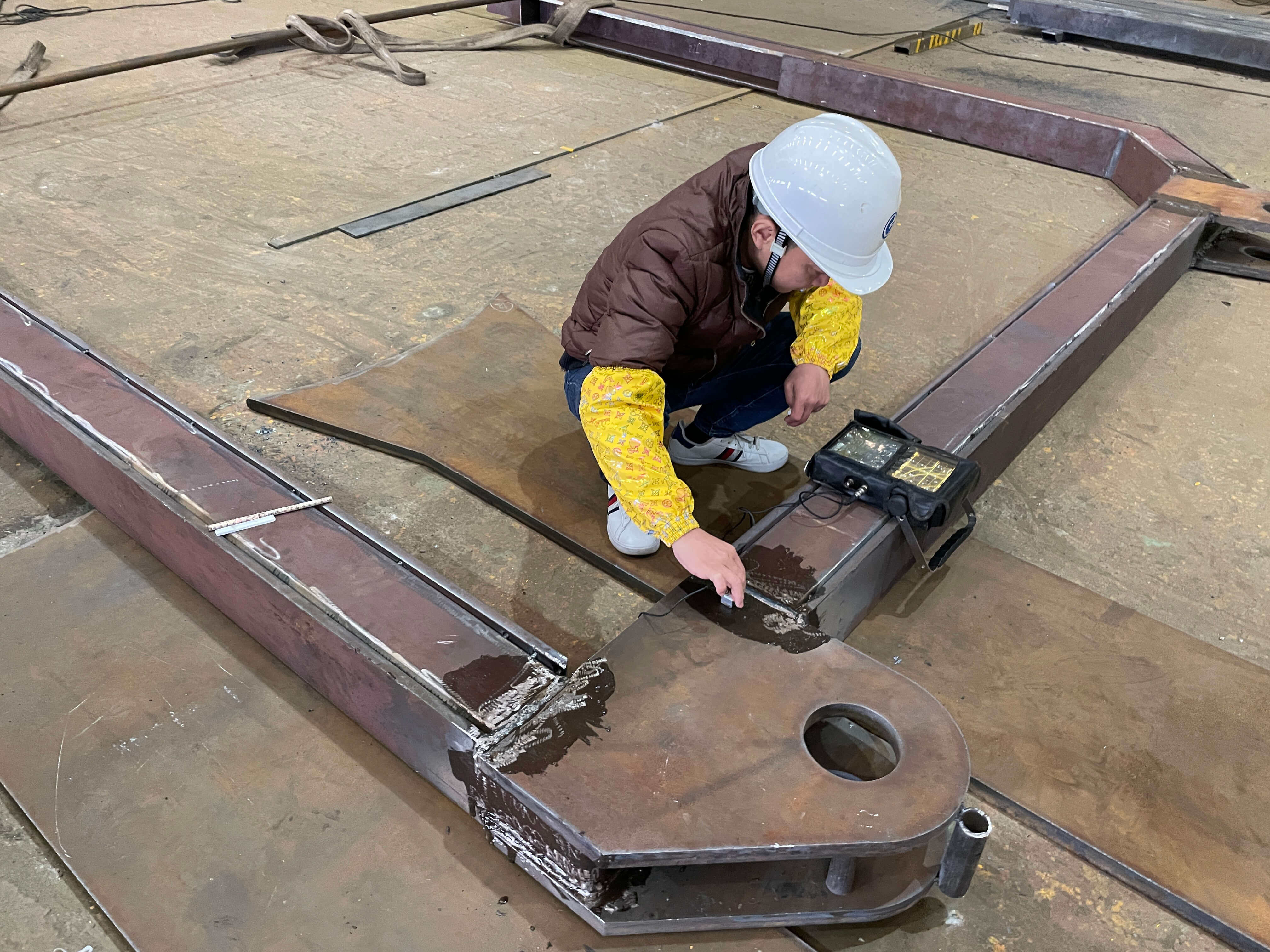
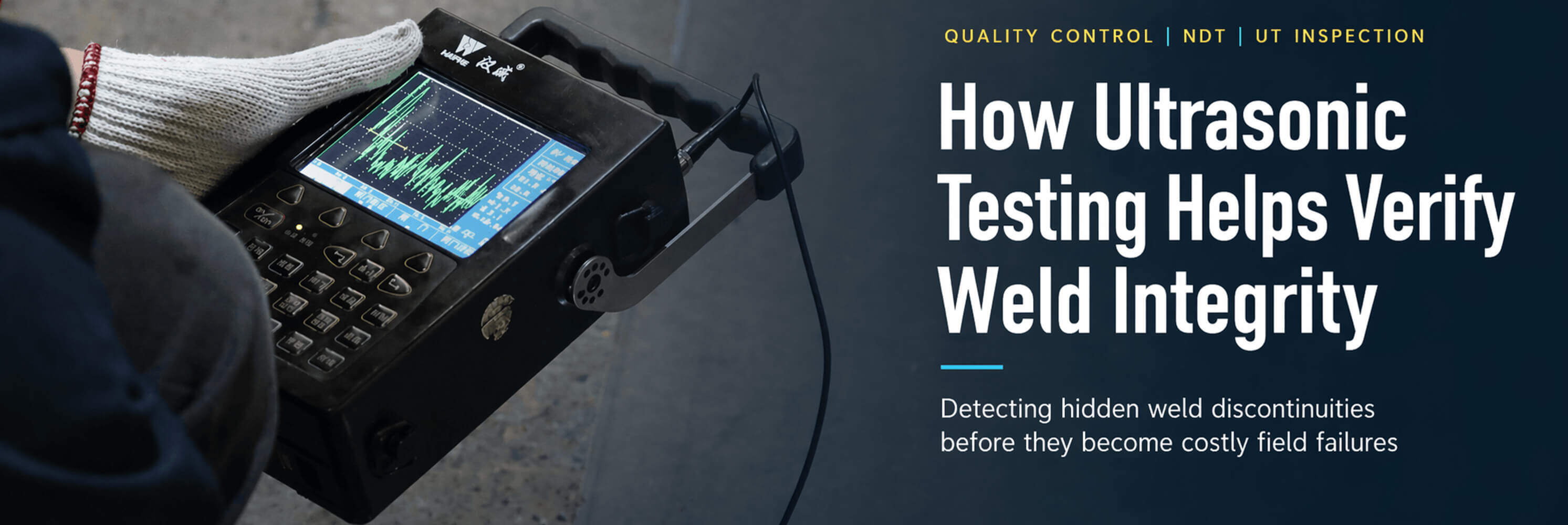
In heavy equipment fabrication, weld quality cannot be judged by appearance alone. A weld may look clean and well-finished on the surface while still containing internal discontinuities that are invisible to the naked eye. That is why manufacturers working on safety-critical or high-load applications rely on non-destructive testing methods to verify what is happening below the surface. Among these methods, ultrasonic testing (UT) is one of the most widely used approaches for weld inspection. High-frequency sound waves can reflect from internal flaws in predictable ways, creating echo patterns that inspectors can analyze without damaging the part.
What Is Ultrasonic Testing in Weld Inspection?
Ultrasonic testing is a non-destructive testing method that uses high-frequency sound energy to examine materials for internal flaws. In weld inspection, a probe introduces sound into the material, and the returning echoes are displayed on an instrument screen for interpretation. TWI notes that weld examination commonly uses ultrasonic probes in the 2 MHz to 5 MHz range, and that a couplant such as grease, paste, or water is used to help transmit the ultrasonic vibrations into the test material.
In practical terms, ultrasonic testing works like this: sound enters the steel, travels through the weld area, and reflects when it encounters a boundary or discontinuity. These reflections help trained inspectors determine whether the weld contains internal conditions that need further evaluation. Because the method is non-destructive, the component remains usable after inspection.
Why UT Is Commonly Used for Welds
Weld inspection is not always suited to straight-beam ultrasound. According to Evident, many common welds require inspection from the side of the weld using an angle beam because of weld geometry, flaw orientation, and the presence of the weld crown or bead. Angle beam testing is described there as the most commonly used technique in ultrasonic flaw detection for welds. By moving the probe back and forth, the sound beam sweeps across the weld volume, allowing the inspector to evaluate fusion lines and the weld body itself.
This matters because weld discontinuities are not always aligned in ways that make them easy to detect with simpler inspection approaches. A good inspection method has to match the geometry of the weld and the way flaws form inside it. That is one reason UT is so valuable in fabrication environments where weld reliability directly affects safety, equipment uptime, and long-term service performance.
What Types of Hidden Weld Discontinuities Can UT Help Reveal?
Ultrasonic testing is commonly used to evaluate welds for internal discontinuities such as cracks, lack of fusion, porosity, and incomplete penetration. Evident’s weld inspection guidance notes that echoes appearing within the weld zone can correspond to lack of fusion, cracking, porosity, or other discontinuities, while TWI explains that incomplete root fusion means one side of the joint root fails to fuse and incomplete root penetration means the root region remains unfused.
For manufacturers and buyers, this is the key point: a visually acceptable weld is not automatically a structurally verified weld. UT helps reveal internal conditions that cannot be confirmed from surface appearance alone. That makes it particularly valuable when the component will operate under demanding loads, repeated service cycles, or critical duty conditions.
Ultrasonic Testing vs Visual Inspection
Visual inspection still matters. It helps identify obvious surface issues, workmanship concerns, weld profile problems, and general fabrication quality. But visual inspection cannot tell you what is happening inside the weld. Ultrasonic testing addresses that gap by using sound reflections to evaluate internal conditions below the surface. In other words, visual inspection tells you what the weld looks like; UT helps you verify whether the weld is internally sound.
That does not mean UT replaces every other inspection method in every situation. Evident notes that radiography and ultrasound are complementary NDT techniques, and both can volumetrically inspect welds and components for defects such as cracks, lack of fusion, and porosity. The right inspection plan depends on the application, material, weld configuration, and project requirements.
Why Weld Integrity Verification Matters in Heavy Equipment Fabrication
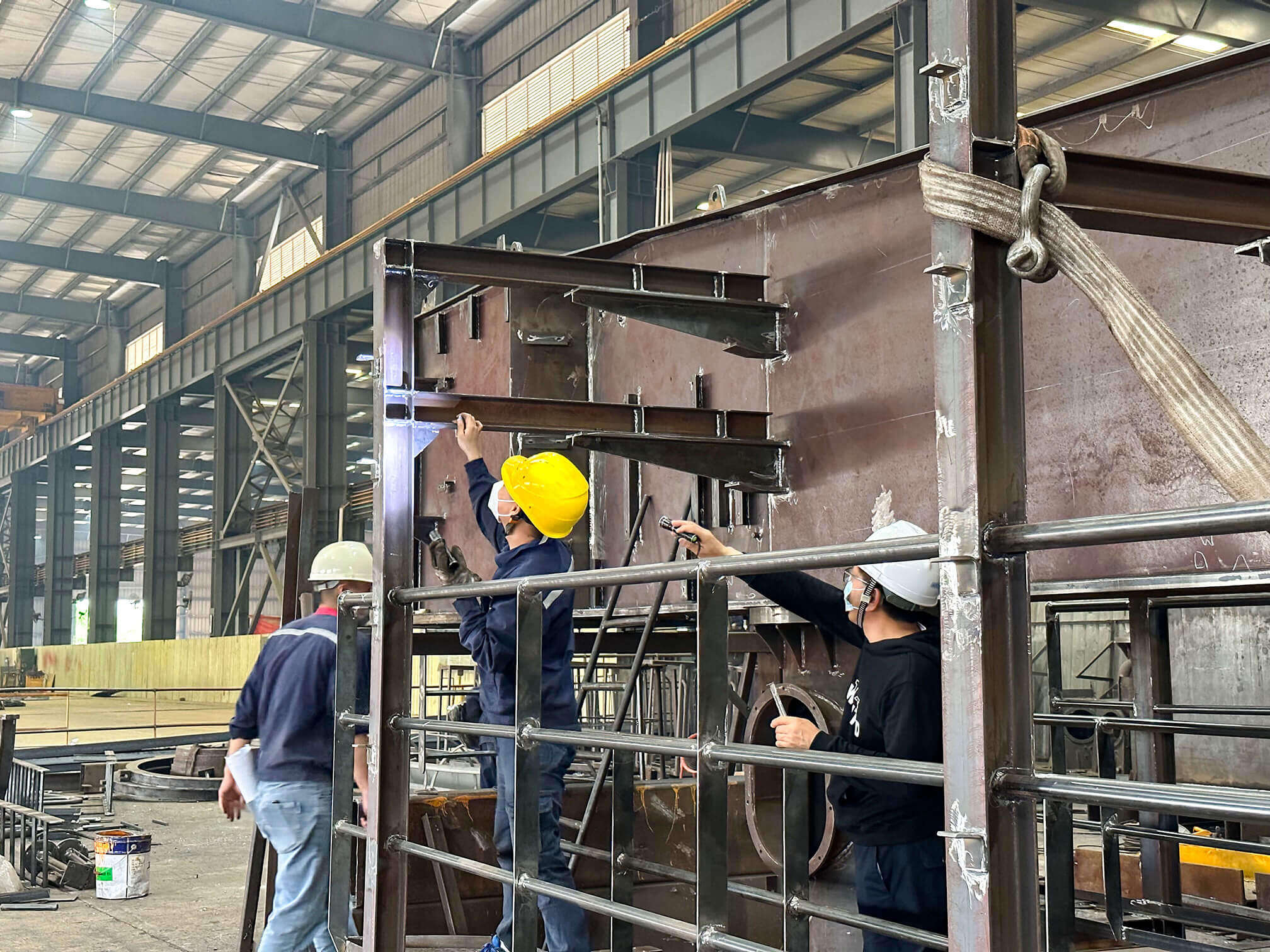
In heavy equipment manufacturing, welds are often part of structures or assemblies that must carry load, resist vibration, and perform reliably over long service periods. If an internal discontinuity goes undetected, the consequences may include rework, delivery delays, costly field repairs, or in the worst case, service failure. That is why high-quality fabrication does not stop at skilled welding alone; it also includes verification. This is especially important when buyers need confidence not only in how a weld looks, but in how it will perform in service.
What Buyers Should Look For in a Fabricator’s Weld Quality Process
If you are evaluating a fabrication partner, ask not only whether they perform NDT, but how they use it in their workflow. Do they explain which welds require UT? Can they show evidence of inspection as part of the production process? Do they document findings, repairs, and reinspection when needed? Do they connect inspection to risk reduction, delivery quality, and long-term performance?